
Walk into a truly memorable interior—one with clarity, conviction, and presence—and you are likely encountering the enduring influence of David Hicks. A pioneering force in interior design, Hicks redefined the language of modern classicism through bold geometry, saturated color, and architectural precision. His rooms did not merely decorate space; they structured it, giving interiors a sense of authority that still resonates in today’s most compelling luxury environments.
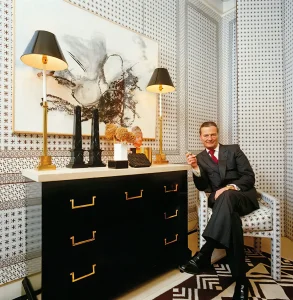 In the 1960s, when English interiors remained rooted in tradition, Hicks introduced something quietly radical. He retained the discipline of classical architecture—symmetry, proportion, and paneling—but infused it with a new visual energy. Floors became fields of pattern, walls carried confident color, and furniture was placed with deliberate, architectural intent. The result was a style that felt both timeless and unmistakably modern, setting a new standard for bold interior design that continues to shape the work of leading designers today.
Hicks worked for roughly 30 years, and throughout that time his appeal was immediate. Clients were drawn not just to how his rooms looked, but to how they felt – ordered yet alive. His signature, often described as Modern Classicism, was rooted in juxtaposition. He combined old and new, restraint and bravado, structure and pattern. The result was interiors that felt resolved but never static. His avant-garde style quickly found favor among London’s upper class and an international clientele, leading to commissions for royalty, nobility, and notable cultural figures. He was light-years ahead of his time, and his ground-breaking style is making a substantial resurgence again today.
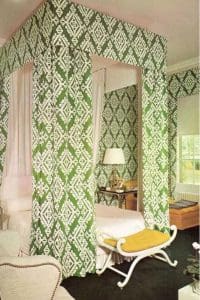
While Hicks garnered fame as a decorator, he was also a designer in the truest sense of the word. Hicks created furniture, textiles, and carpets that carried his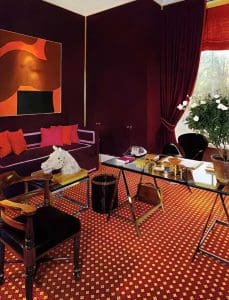 indelible vocabulary into every surface. His hexagons, trellises, and interlocking geometries were not mere decoration. They were critical structure, giving rooms a rhythm in the same way as architecture gives a building its stance.
His influences were wide-ranging, including English country houses, Renaissance proportion, and the clarity of modernism. His true talent was in the editing. He removed hesitation. What remained was unforgettable confidence. The David Hicks’s style is a disciplined fusion of classical architecture and bold modern geometry, highlighted by vibrant color, gloss lacquer finishes, glimmering metals and graphic pattern. His hallmark lies in the deft, precise execution of the delicate balance required to make the traditional interior feel unmistakably current.
 Recognition followed, including his appointment as a Member of the Order of the British Empire (MBE). Yet his real legacy is not institutional. It is visual, and sophisticated designers continue to speak his language.
What is striking is not a sudden revival, but the continuity of influence that has quietly intensified. For decades, Hicks has been a significant reference point among top designers. Today, as interiors move away from minimalism toward rooms with personality and presence, his ideas feel newly urgent. The resurgence of bold geometry, saturated color, and assertive pattern is not coincidence. It is David Hicks reasserting himself.
Hicks did not chase trends. He was a genuine original. He created a unique and immediately recognizable framework. In today’s interiors, where designers once again seek to create spaces that feel composed, intentional, and unmistakably alive, that framework has never felt more relevant.